
www.electronics-usa.com
20
'26
Written on Modified on
STMicroelectronics launches space-grade quad LVDS receiver
The RHFLVDS42 delivers 600 Mbps data rates with enhanced radiation resistance and ESD immunity for aerospace applications.
www.st.com
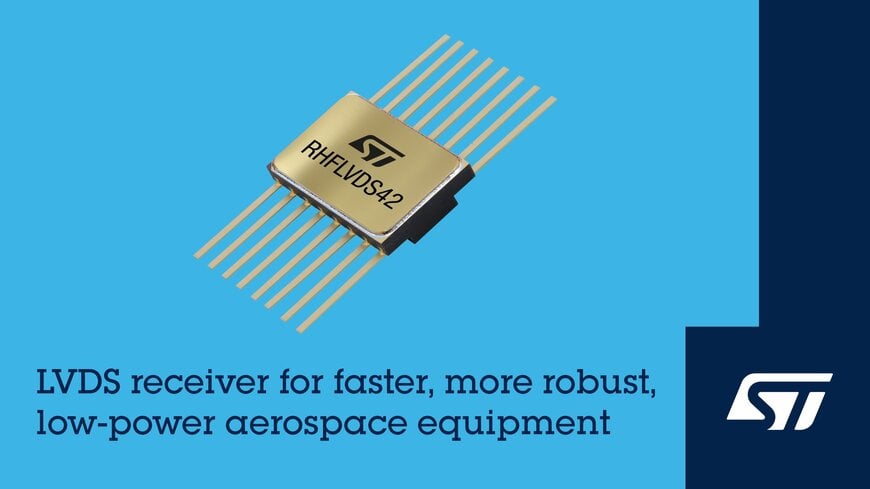
STMicroelectronics has expanded its space-grade component portfolio with the introduction of the RHFLVDS42, a QML-V qualified quad low-voltage differential signaling (LVDS) receiver. Designed for robust aerospace applications, the device supports high-speed data exchanges up to 600 Mbps. Manufactured using ST’s space-proven 130nm CMOS technology in Rennes, France, the receiver is EAR99 compliant, facilitating seamless integration into global aerospace supply chains without restrictive export administration hurdles.
Enhanced noise immunity and radiation tolerance
The RHFLVDS42 operates across a wide supply voltage range of 2.3V to 3.6V, maintaining compliance with TIA/EIA-644 and Jedec norms while ensuring compatibility with legacy CMOS designs. To improve link reliability against common-mode noise, the receiver features a broad input common-mode voltage range extending from -4V to +5V, alongside an absolute maximum voltage rating (AMR) of 4.8V for resilience against power-supply transients. For harsh orbital environments, the device offers 8kV electrostatic discharge (ESD) immunity and exceptional radiation robustness, guaranteeing SEL-free (single event latch-up) operation at 122.6 MeV.cm²/mg, SET/SEU-free (single event transient/upset) operation at 61.3 MeV.cm²/mg, and total ionizing dose (TID) stability up to 300 krad (Si).
Space-optimized hermetic packaging
Operating reliably in extreme temperatures ranging from -55°C to +125°C, the RHFLVDS42 is supplied in a grounded-lid Flat-16 hermetic package. This configuration utilizes a flow-through pinout design that reduces signal crosstalk and optimizes printed circuit board (PCB) real estate. For satellite payloads and deep-space probes where minimizing weight and volume is highly critical, STMicroelectronics also offers the receiver as a bare die.
Additional Context: QML-V qualification and space-grade LVDS
This section details technical specifications and competitive benchmarking not included in the original product announcement.
Deploying commercial-off-the-shelf (COTS) silicon in orbital environments exposes microelectronics to severe ionizing radiation and heavy ion bombardment, which can cause Single Event Latch-ups (SEL) that permanently destroy standard CMOS logic. To survive multi-year space missions, components must undergo rigorous testing to achieve QML-V (Qualified Manufacturers List, Class V) certification, the highest standard for aerospace microelectronics established by the Defense Logistics Agency (DLA). The 300 krad (Si) Total Ionizing Dose (TID) resilience ensures the device will not degrade from cumulative radiation exposure over long operational lifespans in Geostationary Earth Orbit (GEO) or deep space. Furthermore, Low-Voltage Differential Signaling (LVDS) is critical in modern satellite bus architectures, allowing high-speed telemetry and high-resolution sensor data to be transmitted over long cable runs with minimal electromagnetic interference (EMI) and exceptionally low power consumption compared to legacy RS-422 standards.
Edited by an industrial journalist, Lekshman Ramdas, with AI assistance.
www.st.com
