
www.electronics-usa.com
22
'26
Written on Modified on
Low-Noise LDO Regulator for Sensitive Power Rails
Toshiba's TCR5FF series in SOT-25 packaging improves load transient response to stabilise power supplies in cameras, sensors and IoT equipment.
www.global.toshiba
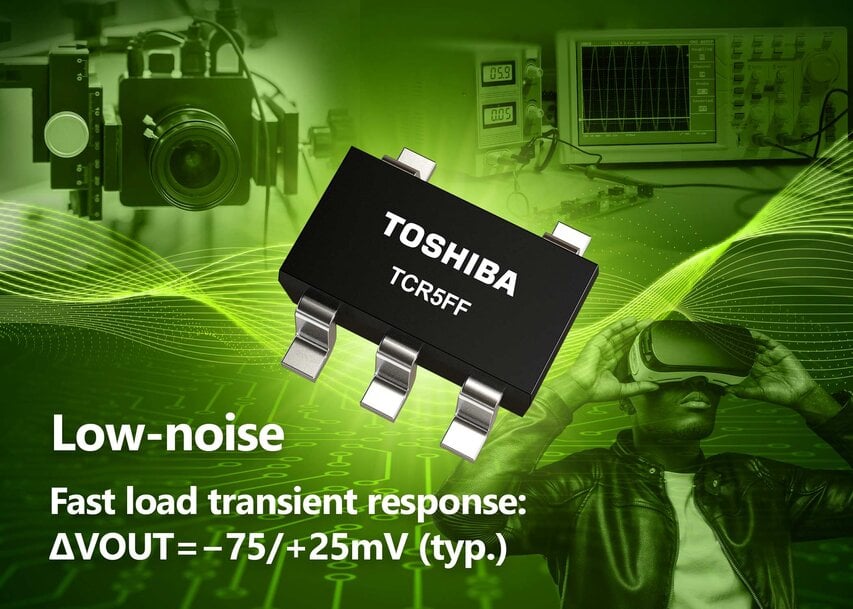
In security cameras, industrial cameras, high-precision sensors and IoT equipment, sudden load changes disturb the supply voltage. Toshiba Electronics Europe addresses this requirement with the TCR5FF series, a range of 35 low-dropout (LDO) regulators for noise-sensitive consumer and industrial applications.
Load Variations and Power Supply Noise
Electronic systems increasingly combine fast digital processing with sensitive analogue circuits and frequently switch between low-power standby and active operation. Each transition causes a current step that the regulator must compensate. If its control loop responds too slowly, the output voltage dips or overshoots, which can degrade the accuracy of an analogue-to-digital converter, the image quality of a sensor or the stability of an RF circuit. Stable voltage regulation therefore becomes a design parameter in its own right.
TCR5FF Series Architecture
The TCR5FF series combines the electrical characteristics of Toshiba's existing TCR5FM series with a compact SOT-25 package. This leaded package simplifies PCB assembly and allows easy visual inspection of solder joints after mounting, an advantage for quality control in production.
Compared with the TCR3RM series, load transient response when leaving standby mode is improved by around 80 %. Output voltage variations therefore remain small, even during abrupt load changes.
Ripple Rejection and Output Noise
The ripple rejection ratio (PSRR) reaches 91 dB typical at 1 kHz. This value results from the combination of a bandgap reference circuit, a low-pass filter and a high-speed, low-noise operational amplifier. The filter limits noise generated by the voltage reference, while the fast amplifier corrects disturbances arriving from the input. Output noise voltage is 5 µVrms typical, making the series suitable for analogue, RF and noise-sensitive sensor circuits.
Technical Specifications
TCR5FF devices supply output currents up to 500 mA and operate from -40 °C to +125 °C. They are offered with fixed output voltages from 0.9 V to 5.0 V, allowing designers to select the appropriate device for each power rail. The SOT-25 package measures 2.9 × 2.8 mm, a common format for five-pin linear regulators.
Industrial Applications
In a surveillance camera, the regulator can supply the image sensor and its analogue signal chain, where supply noise translates directly into image noise. In an IoT sensor node that wakes periodically to measure and transmit, fast transient response limits voltage dips when switching to active mode. Toshiba also lists solid-state drives among the target applications. The company plans to extend its LDO regulator range to meet evolving power management requirements.
Additional Context
This section details technical specifications and competitive benchmarking not included in the original product announcement.
Low-noise LDO regulators in SOT-23-5 packages, equivalent to SOT-25, form an established product category. As a reference, the Texas Instruments TPS7A20, also available in a five-pin SOT-23 package, specifies 300 mA output current, 7 µVrms output noise and 95 dB PSRR at 1 kHz, with output voltages from 0.8 V to 5.5 V and an operating range of -40 °C to +125 °C. The TCR5FF series offers a higher output current of 500 mA and lower typical output noise of 5 µVrms, while the TPS7A20 shows slightly higher PSRR at 1 kHz. As noise measurement conditions can differ between manufacturers, a precise comparison requires consulting the respective datasheets.
Edited by Sucithra Mani, Induportals editor – adapted by AI.
www.toshiba.semicon-storage.com
