
www.electronics-usa.com
30
'26
Written on Modified on
Microchip Expands PolarFire FPGA Networking Stack
Industrial edge networking stack enables real-time communications for AI automation, robotics and Industry 4.0 applications.
www.microchip.com
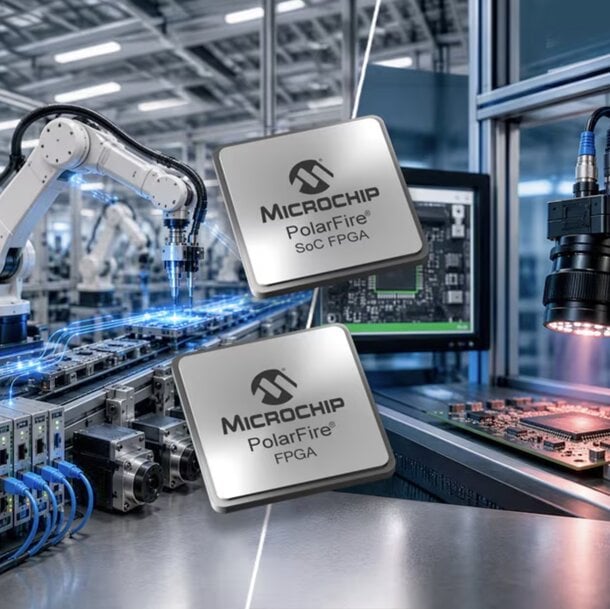
Industrial automation architectures face compounding communication bottlenecks as artificial intelligence inference, high-speed machine vision, and collaborative multi-axis robotics converge at the edge. Modern factory environments demand deterministic, microsecond-level synchronization across distributed control nodes while simultaneously funneling high-bandwidth sensory and diagnostic traffic into enterprise computing clouds. Historically, achieving this coexistence required deploying dedicated external application-specific integrated circuits (ASICs) alongside separate host processors, increasing overall system complexity, printed circuit board footprint, and operational power consumption. Furthermore, conventional static networking controllers lack the architectural adaptability to pivot between legacy fieldbus protocols and emerging Ethernet standards. Overcoming these integration hurdles requires programmable, low-power system-on-chip architectures that combine secure non-volatile silicon fabric with certified industrial Ethernet intellectual property cores to guarantee deterministic latency under stringent thermal envelopes.
Multi-Rate EtherCAT and Gigabit TSN Implementation
To resolve connectivity and processing constraints across distributed industrial topologies, Microchip Technology has broadened its industrial edge networking solution stack by adding EtherCAT and Time-Sensitive Networking (TSN) capabilities across its PolarFire FPGA and PolarFire SoC product lines.
The enhanced solution stack incorporates Beckhoff Automation EtherCAT intellectual property (IP), which is compatible with both standalone PolarFire FPGAs and multi-core PolarFire SoC devices. The Beckhoff core delivers scalable industrial Ethernet connectivity across 10, 100, and 1,000 Mbps transmission speeds. Concurrently, Microchip introduced its proprietary TSN IP core, designed specifically for PolarFire FPGA SoCs to implement deterministic, low-latency 1 Gbps Ethernet backbones compliant with IEEE 802.1 TSN standards. By co-locating deterministic motion protocols and time-synchronized packet routing within the programmable logic fabric, system designers can construct scalable industrial network backbones that maintain predictable latency, jitter mitigation, and cross-vendor device interoperability.
Shakeel Peera, Vice President of Microchip's FPGA business unit, indicated that edge AI migration is requiring industrial network topologies to transition toward intelligent, data-driven decentralized processing. Peera noted that embedding EtherCAT and TSN into the low-power PolarFire architecture equips embedded developers with the determinism required for high-responsiveness factory infrastructure.
Hardware Architecture, Prototyping Kits, and Embedded Security
The networking stack leverages the underlying hardware characteristics of the PolarFire family, which is engineered around a power-efficient, non-volatile Flash-based architecture. The non-volatile configuration fabric eliminates external configuration memories, delivering instant-on execution and inherent resistance to single-event upsets (SEU) in electrically noisy manufacturing cells. Hardware-level cybersecurity mechanisms are integrated into the devices, including cryptographically verified secure boot, differential power analysis (DPA) countermeasures, and active physical anti-tamper protections.
Target deployments for the stack encompass multi-axis motion controllers, industrial robotic workcells, embedded inspection cameras, autonomous mobile robots (AMRs), automotive subsystems, smart grid infrastructure, and aerospace-and-defense networks. To accelerate prototyping, development is supported through the Libero SoC Design Suite, reference architectures, the Dual-Port Gigabit Ethernet FMC Daughter Card (ETH-DC-DUALGBE), and the PolarFire SoC Video Kit (MPFS250-VIDEO-KIT).
Additional Context
This section details technical specifications and competitive benchmarking not included in the original product announcement.
Industrial Ethernet deployments bridging field execution and enterprise management rely on synchronized timing defined by the IEEE 802.1AS Precision Time Protocol and deterministic traffic scheduling governed by IEEE 802.1Qbv time-aware shapers. Within standard operational-technology/information-technology (OT/IT) converged backbones, TSN utilizes frame preemption (IEEE 802.1Qbu) and cyclic queuing to prioritize critical motion-synchronization packets over background video or telemetry streams on the same physical link. In PolarFire SoC devices, this logic fabric interfaces directly with a hardened multi-core 64-bit RISC-V microprocessor subsystem operating in an asymmetrical multiprocessing (AMP) mode, allowing one CPU cluster to execute real-time control routines within a deterministic cache while adjacent cores manage real-time Linux networking stacks and edge analytics.
Within the industrial programmable logic and smart networking market, Microchip's PolarFire FPGA and SoC stack competes directly with programmable solutions from AMD (AMD Xilinx Zynq-7000 and Zynq UltraScale+ MPSoC running industrial Ethernet IP), Intel (Agilex 3 and Cyclone V/10 families), and specialized fieldbus ASICs from Analog Devices (ADI Chronous series) and Renesas (R-IN32/RZ/T2 series). While SRAM-based architectures from AMD and Intel typically require external non-volatile boot PROMs and consume significant static leakage power—frequently requiring active heatsinks or fans that compromise IP67 sealed enclosure designs—PolarFire's Flash-based process consumes up to 50 percent lower static power and is naturally immune to radiation-induced configuration bit flips. By pairing hard RISC-V cores with validated 1-Gbps EtherCAT and TSN IP cores inside a single low-power package, Microchip eliminates peripheral PHY-management microcontrollers, reducing overall component counts on safety-critical industrial floorboards.
Edited by Romila DSilva, Induportals Editor, with AI assistance.
www.microchip.com
