
www.electronics-usa.com
13
'26
Written on Modified on
Telit Cinterion Introduces SE250C4 Smart Module
New series brings local AI acceleration and real-time processing to industrial and connected-device designs.
www.telit.com
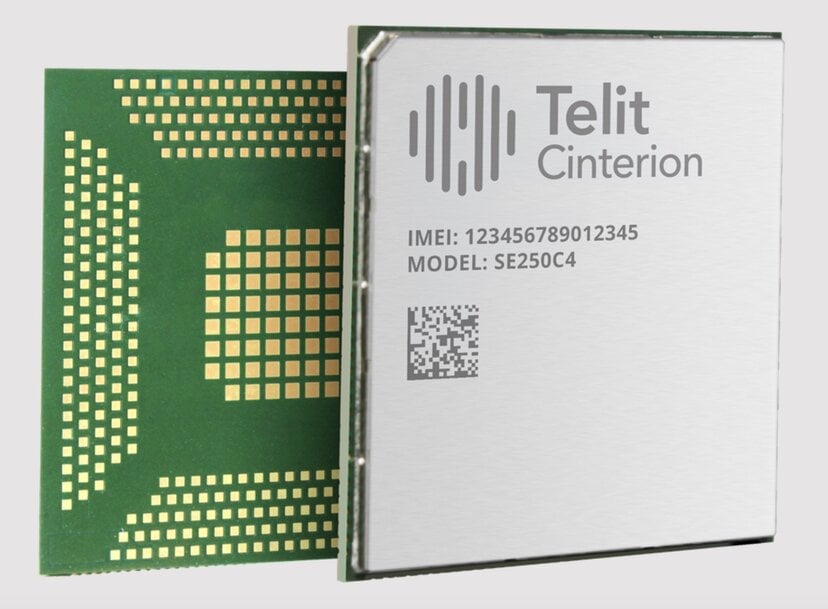
Original equipment manufacturers developing edge-intelligent industrial terminals, autonomous robotics, and vision-enabled gateways face mounting pressure to execute machine learning inference, deterministic control loops, and rich graphical user interfaces on compact, power-constrained hardware. Historically, consolidating these distinct workloads required multi-chip printed circuit board topologies—pairing an application processor for operating systems and displays with a separate neural processing accelerator and an external real-time microcontroller for deterministic fieldbus and motor control. This multi-chip approach increases bill-of-materials costs, expands board footprint, complicates inter-processor communication, and extends electromagnetic compliance certification timelines. Furthermore, migrating existing deployed products to support local computer vision and deterministic Ethernet without altering physical carrier-board footprints has remained difficult when upgrading from legacy entry-level smart modules. Overcoming these design constraints requires heterogeneous system-on-module architectures that unite multi-core application compute, dedicated neural acceleration, deterministic real-time microcontrollers, and industrial networking inside backward-compatible form factors.
Heterogeneous Compute and Backward-Compatible Form Factor
To streamline edge AI hardware integration without forcing carrier-board redesigns, Telit Cinterion announced the SE250C4 series, a new generation of smart modules powered by the Qualcomm Dragonwing Q-2390 processor from Qualcomm Technologies, Inc. Engineered in the same 41 by 43 millimeter land grid array (LGA) package footprint established by the preceding SE250B4 series, the SE250C4 enables straightforward hardware upgrades across existing customer designs while expanding onboard compute capabilities.
The heterogeneous silicon architecture integrates a quad-core CPU cluster pairing one high-performance Arm Cortex-A78 core with three power-efficient Arm Cortex-A55 cores, alongside a Qualcomm Adreno 704 GPU capable of rendering 3D graphics and driving Full HD displays. For edge machine learning tasks, an integrated Qualcomm Hexagon neural processing unit delivers 1.1 trillion operations per second (TOPS) of dedicated on-device AI compute. Crucially, the module incorporates an embedded RISC-V microcontroller dedicated to deterministic real-time tasks, isolating time-critical sensing and control functions from high-level operating system latency.
Industrial Connectivity, Vision Interfaces, and Regional Variants
Designed for vision-enabled edge devices, robotics, industrial automation, smart retail payment terminals, and surveillance systems, the SE250C4 features native camera interfaces alongside Full HD display outputs. Executing computer vision and inference models locally on the module reduces cloud bandwidth consumption, lowers decision latency, and strengthens data privacy.
To interface with factory networks and peripheral hardware, the module provides dual Ethernet ports supporting Time-Sensitive Networking (TSN), a PCIe Gen2 lane, and two USB interfaces. Compared to the previous-generation SE250B4, the SE250C4 adds dedicated AI acceleration, the real-time RISC-V subsystem, and Full HD display capability within identical physical dimensions. Telit Cinterion offers the platform in two regional connectivity configurations: the SE250C4-EU, which provides LTE Cat 4 cellular connectivity for Europe, China, and select international regions alongside multi-constellation GNSS (GPS, GLONASS, BeiDou, and Galileo), and the SE250C4-WE, a worldwide Wi-Fi-only non-cellular variant.
Additional Context
This section details technical specifications and competitive benchmarking not included in the original product announcement.
In embedded industrial computing and deterministic edge networking governed by IEEE 802.1 Time-Sensitive Networking standards, combining non-deterministic high-level operating systems—such as Android or Yocto Linux—with real-time control requires strict hardware partitioning. High-level operating systems introduce unpredictable interrupt latency due to memory garbage collection, thread scheduling, and graphical rendering pipelines. Integrating a dedicated RISC-V microcontroller running a real-time operating system like Zephyr alongside the primary Arm Cortex-A78/A55 application cluster allows system architects to handle pulse-width modulation, motor commutation, and deterministic TSN packet scheduling independently of application CPU loads. Concurrently, the Qualcomm Spectra image signal processor pipeline supports dual camera inputs via MIPI CSI interfaces, feeding hardware-accelerated INT8/FP16 inference pipelines on the Hexagon NPU without saturating system memory bandwidth. From a regulatory standpoint, utilizing a pre-certified LGA smart module with integrated RF front-ends, thermal pads, and hardware-backed security (including Trusted Execution Environment and hardware key management) accelerates compliance with European Radio Equipment Directive (RED) and Cyber Resilience Act (CRA) requirements.
Within the industrial smart module and embedded system-on-module (SoM) sector, Telit Cinterion’s SE250C4 benchmarks directly against cellular and Wi-Fi smart modules from Quectel (such as the SC200E and SG368Z series), Fibocom (SC138 and SQ808 series), and Sierra Wireless / Semtech, as well as industrial computer-on-modules from Toradex (Verdin iMX8M Plus and Verdin AM62) and Phytec. While traditional industrial SoMs based on NXP i.MX 8M Plus or Texas Instruments AM62x processors offer strong industrial temperature ratings and real-time Cortex-M cores, they typically lack integrated cellular modems, requiring OEMs to design separate M.2 or mini-PCIe radio interfaces and undergo costly carrier certifications. Conversely, legacy cellular smart modules—including Telit Cinterion's own QCM2290-based SE250B4—lacked dedicated NPU silicon and deterministic TSN Ethernet ports. By combining Qualcomm's Dragonwing Q-2390 heterogeneous SoC, 1.1 TOPS of AI compute, dual TSN Gigabit Ethernet, and pre-certified LTE Cat 4 or Wi-Fi connectivity into an established 41 by 43 mm footprint, Telit Cinterion delivers an integrated single-module upgrade path for industrial HMI manufacturers, autonomous mobile robot builders, and smart retail terminal OEMs.
Edited by Romila DSilva, Induportals Editor, with AI assistance.
www.telit.com
