
www.electronics-usa.com
27
'26
Written on Modified on
650 V Fast Recovery Rectifiers for PFC and On-Board Chargers
Nexperia's PNU and PNE rectifiers in DPAK Real-2-Pin packages balance conduction and switching losses in automotive and industrial power conversion.
www.nexperia.com
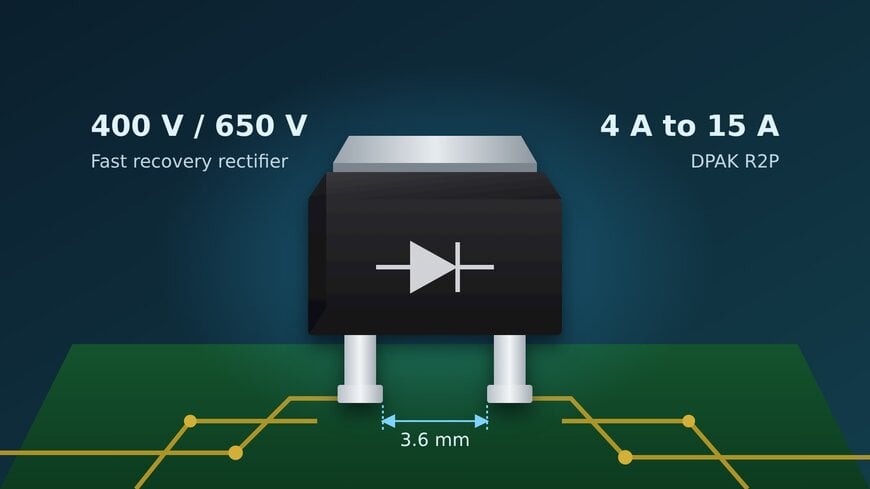
In power factor correction (PFC) stages and other hard-switched converters, the boost diode is a key source of losses. Its forward voltage determines conduction losses, while its reverse recovery behaviour determines switching losses and electromagnetic interference. Nexperia has introduced a series of 400 V and 650 V silicon fast recovery rectifiers that allow designers of automotive and industrial power conversion systems to choose the trade-off between these two loss mechanisms that best suits their application.
Why Reverse Recovery Matters in Power Conversion
When a silicon PN diode switches from forward conduction to blocking, stored charge must be removed before the junction can block voltage. This reverse recovery current flows through the switching transistor, increasing its turn-on losses and generating voltage overshoot and noise. Faster recovery reduces these losses but usually comes at the cost of a higher forward voltage drop. The optimum device therefore depends on switching frequency, current level and operating conditions.
Ultrafast and Hyperfast Rectifier Options
The new portfolio comprises 48 devices with current ratings from 4 A to 15 A and is divided into two families. The ultrafast PNU devices are optimised for low forward voltage, while the hyperfast PNE devices prioritise short reverse recovery. Both offer smooth switching behaviour. As an example, the 650 V, 10 A PNU650100EH has a typical forward voltage of 1.2 V and a typical reverse recovery time of 27 ns.
DPAK Real-2-Pin Package for Higher Creepage Distance
The rectifiers are housed in a DPAK (TO-252) Real-2-Pin (R2P) package. By removing the centre lead of the conventional DPAK, the R2P version increases the spacing between anode and cathode to 3.6 mm. The greater creepage and clearance distance supports insulation coordination in high-voltage designs, where pollution degree, working voltage and board layout determine the minimum spacing between conductors.
Applications in On-Board Chargers, Power Supplies and HVAC
Nexperia positions the series as boost diodes for PFC in single-phase, low-power automotive on-board chargers, industrial power supplies and air conditioning systems. In these circuits, the diode operates at the full output voltage of the PFC stage, typically around 400 V, which makes 650 V devices a common choice with voltage margin.
"The optimum rectifier characteristics depend strongly on the application and its specific operating conditions," said Ole Thomsen, Product Manager for Recovery Rectifier at Nexperia. "By offering both ultrafast and hyperfast recovery options across a broad range of current and voltage ratings, we enable designers to choose the device that best matches their individual system requirements."
Silicon and Silicon Carbide in One Portfolio
The fast recovery rectifiers complement Nexperia's existing power diode technologies, including its silicon carbide (SiC) Schottky rectifiers. This gives designers a range from cost-optimised silicon solutions to high-performance SiC devices. "Combining low forward voltage, fast switching and soft reverse recovery with the increased creepage and clearance distances of the Real-2-Pin DPAK package, we help customers meet the demands of automotive and industrial power applications," said Guido Boyer, Head of Product for Bipolar Discretes at Nexperia.
Additional Context:
This section details technical specifications and competitive benchmarking not included in the original product announcement.
Silicon fast recovery diodes and SiC Schottky diodes are the two established technologies for PFC boost diodes. SiC Schottky diodes are majority-carrier devices with practically no reverse recovery charge, which makes them suitable for high switching frequencies and continuous conduction mode PFC, but they are generally more expensive. Silicon ultrafast and hyperfast diodes remain widely used in cost-sensitive and lower-power designs, particularly in critical conduction mode PFC, where the diode current falls to zero before each switching cycle and recovery losses are therefore lower. Minimum creepage and clearance distances for low-voltage equipment are defined in IEC 60664-1 and product standards derived from it, which is why lead spacing in surface-mount power packages is an important selection criterion for designs operating at several hundred volts. For automotive applications, discrete semiconductors are typically qualified according to AEC-Q101.
Edited by Natania Lyngdoh, Induportals editor, with AI assistance.
www.nexperia.com
