
www.electronics-usa.com
20
'26
Written on Modified on
Radiation-Tolerant FPGAs Gain QML Class V Spaceflight Qualification
Microchip extends its PolarFire RT portfolio with flight-ready qualifications that widen component options for high-reliability satellite and deep-space processing systems.
www.microchip.com
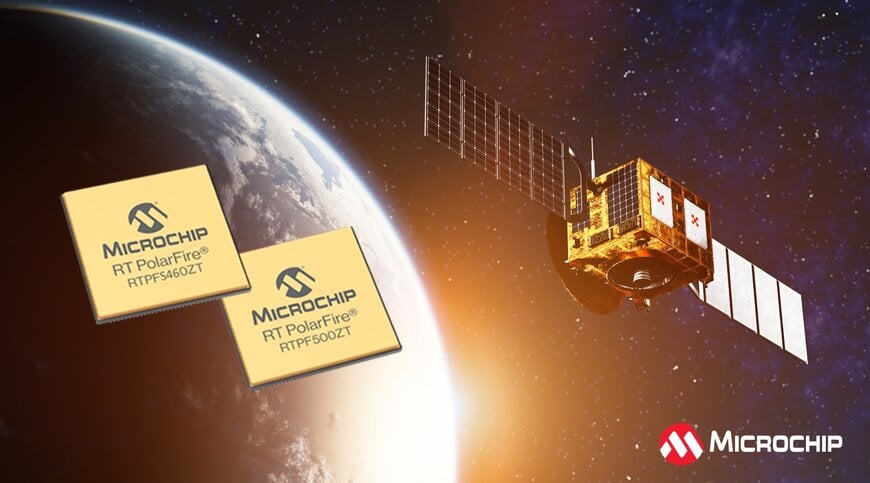
Microchip Technology has added new spaceflight qualifications to its radiation-tolerant PolarFire RT FPGA and SoC families. The RTPF500ZT FPGA has obtained Qualified Manufacturers List (QML) Class V qualification from the US Defense Logistics Agency (DLA), the highest qualification level for space microelectronics, while the RTPFS460ZT SoC FPGA has achieved QML Class Q and MIL-STD-883 Class B qualification.
Configuration Technology Without Periodic Scrubbing
Most SRAM-based FPGAs require periodic scrubbing of their configuration memory to correct radiation-induced errors, which can go undetected between scrubbing cycles and increase power consumption. PolarFire RT devices use a configuration technology designed to eliminate single-event upset (SEU) issues. Their efficient operation helps manage the thermal limits of space platforms, military-grade security protects critical systems, and overall system complexity is reduced.
“Space applications require increasingly greater on-board processing capabilities under ever tighter SWaP budgets. Developers need technologies that maximise performance without increasing power consumption or complicating thermal management,” says Shakeel Peera, vice president of Microchip’s FPGA business unit. “Our PolarFire RT portfolio combines an efficient radiation-tolerant architecture, designed to be immune to radiation-induced upset risks, with military-grade security, so that developers can reduce system power, simplify thermal management and build highly integrated mission-critical space systems.”
QML-V FPGA and RISC-V SoC for Space Missions
The flight-proven, QML-V qualified RTPF500ZT FPGA integrates single-event latch-up (SEL) protection and in-flight programmability for mission-critical space applications that demand high reliability. The RTPFS460ZT SoC FPGA combines programmable logic with an integrated microprocessor subsystem (MSS) featuring 64-bit RISC-V processor cores and is certified to MIL-STD-883 Class B and QML Class Q.
Target applications range from satellite payloads and satellite constellations to crewed spacecraft and deep-space exploration missions.
MIL-STD-883 and QML Qualification Requirements
MIL-STD-883 and QML qualifications set testing, manufacturing and quality requirements for microelectronic components used in high-reliability aerospace and defence applications. MIL-STD-883 defines standardised test methods covering environmental, mechanical and electrical characteristics, while QML Class V, defined by MIL-PRF-38535, establishes the quality assurance and reliability requirements for components intended for space applications.
Development Tools for Flight System Design
The RTPFS460ZT development kit enables evaluation and prototyping of PolarFire RT FPGAs and SoCs. Both devices are supported by Microchip’s Libero SoC design suite for overall design and development, and by the Mi-V ecosystem for RISC-V development, providing a consistent environment to evaluate the architecture, validate designs and reuse engineering work through to flight hardware.
Additional Context
This section details technical specifications and competitive benchmarking not included in the original news release.
AMD’s Kintex UltraScale XQRKU060 is a radiation-tolerant, SRAM-based space-grade FPGA offering 331,000 CLB LUTs, 32 transceivers at 12.5 Gbps, a total ionising dose (TID) rating of 100 krad and single-event latch-up immunity above an LET of 80 MeV·cm²/mg. It is screened to AMD’s QML-compliant B and Y test flows and uses more than 40 patented circuit design and layout techniques to reduce its SEU cross-section. The RTPF500ZT has now attained QML Class V, and unlike SRAM-based devices, the RT PolarFire architecture is designed to eliminate vulnerability to radiation-induced configuration upsets rather than relying on configuration scrubbing.
Edited by Aishwarya Mambet, Induportals Editor, with AI assistance.
www.microchip.com
